When husband and father of two, TM, collapsed one afternoon at home he suffered a life-changing cerebral bleed and hydrocephalus that left him in a Prolonged Disorder of Consciousness (PDOC) state for more than 11 months. But his family never lost their faith and miraculously TM emerged from PDOC last Summer (August 2023) and began an intensive rehabilitation programme led by the specialist MDT at The Bridge Neurological Centre in Middlesbrough.
With his family by his side every step of the way, TM has surpassed all expectations regaining communication, balance and purposeful movement and is now able to stand up in the hydrotherapy pool and take steps. Through collaborative working and expert care by the full therapy team, (including Physiotherapists, Speech and Language Therapists, Occupational Therapists and the Nursing and support staff), TM continues to achieve remarkable progress in his rehabilitation. He now hopes to return to his specially adapted home and be an integral part of his loving family once more.
This is the story of TM’s inspiring rehabilitation journey told from the perspective of TM, TM’s family who actively supported his care throughout and the specialist MDT involved in his neurorehabilitation.

Initial presentation: cerebral bleed and hydrocephalus
TM was originally referred to The Bridge from the acute hospital HDU following a cerebral bleed and hydrocephalus in September 2022. He was in PDOC state and required a tracheostomy with a GCS of 5-9. On admission there were no signs of communication, either verbal or non-verbal and no purposeful movement. TM relied on all nutrition and medication via PEG tube and was nil by mouth with an unsafe swallow and non-communicative pain response.
He was admitted for ongoing neurological and respiratory care and maintenance from the physiotherapy team including full passive limb stretches and full postural support. As he was fully bed bound, he required hoist transfers by two people as well as input from the full therapy team for the continued assessment of his PDOC status.
In August 2023, to the incredible joy of his family, TM emerged from PDOC state. TM’s wife says that that the joy she felt as TM emerged was overwhelming and that it was a very emotional time. “I felt emotional, overjoyed and tearful.” TM has also confirmed that he remembers that he “felt happy too”.

Getting the right start in rehab
TM could now begin his rehabilitation programme at The Bridge with the specialist MDT team. Lead Physiotherapist, Nicholas Dougherty, who jointly led TM’s rehabilitation, explains how if an MDT is able to work with an individual from an early point in their rehabilitation, then the right foundations can be put in place to give them the best possible chance of recovery.
Nicholas says: “In the case of TM he had specialist input at that foundational level. We completed a full assessment, using the ITAT (Initial Therapy Assessment Tool), which incorporates all appropriate demographic data, past medical history, and present condition. The whole MDT then contributed to his rehab plan.
“My role as a Lead Physiotherapist was to support TM’s holistic physical well-being. As part of his initial assessment, we reviewed his full range of passive and active movements for his limbs, trunk, head and neck. We incorporated proprioception and sensation, noting any deficit, contractions, or reduction in normal movement. TM also began a comprehensive stretching and positional programme including a sleep system which was run by our specialist Occupational Therapy team.
“TM had a tracheostomy in situ, so we also completed a full breathing assessment, including assessing the level of risk for the resident, under the supervision of Consultant Intensivist Dr Gonzalez who works as part of the MDT at The Bridge as well as at The James Cook University Hospital.
Within The Bridge we work with residents with varying levels of medical acuity including residents requiring ventilation who have a higher level of risk, but we have the skills and experience within our team to successfully manage their care. We currently care for several residents who need tracheostomy care and ventilation management.”

Tracheostomy care – implementing a weaning programme for TM
Once it was confirmed safe to do so by the consultant, TM began a graded weaning programme. Lead Physiotherapist, Nicholas Dougherty explains the gradual phases of this complex procedure.
Nicholas says: “First we started by taking all basic observations such as respiration rate, heart rate, work of breathing, and saturations. If all parameters are fine, capping off the tracheostomy with a blue cap commences which allows the patient to breathe through the upper airway (the nose and mouth). This process has to be gradually performed and under constant supervision, as it increases the pressure on the diaphragm and the respiratory muscles. We must ensure respiration and work of breathing does not increase and saturations do not drop below adequate levels. We then extended this to 10 minutes and gradually increased over time until we got to a point where TM could go up to 12 hours with a cap on during daylight hours.
“Once TM achieved 12 hours with a blue cap in-situ in daylight hours, we completed Transcutaneous Carbon Dioxide Monitoring (TOSCA) overnight with his blue cap in-situ, which measured his CO2 levels. During the night TM’s observations would increase to ensure his work of breathing did not increase during his sleep. TOSCA results showed CO2 levels were within the normal ranges which meant that he was not retaining CO2, and he was suitable for decannulation (the process of removal of the tracheostomy). To complete this process, a bed was reserved in HDU at James Cook University Hospital where decannulation took place and TM was observed overnight. After successful decannulation TM was able to return to The Bridge to continue his rehabilitation.
“Decannulation is quite an intense process for both the individual receiving rehabilitation and their family. Having a tracheostomy is a life-changing intervention and whilst it is in place it requires skilled care to ensure its safety is being managed and that the airway is always patent. If possible, decannulation is better for the general wellbeing of the individual as the overall care risk reduces, but it’s also much more beneficial for the family really because they can see progress and can remain optimistic about their future.”

Due to the increased independence it provides, decannulation can become a rehab goal for residents and families alike, right from the start of their rehabilitation programme.
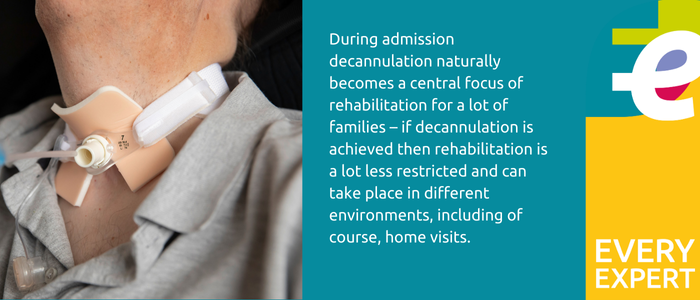
Nicholas says: “During admission decannulation naturally becomes a central focus of rehabilitation for a lot of families – if decannulation is achieved then rehabilitation is a lot less restricted and can take place in different environments, including of course, home visits. As a Lead Physiotherapist it is important to liaise with family to ensure all aspects of weaning leading to decannulation are performed safely and in a timeframe which would not lead to deterioration of the person.”
“Even before TM regained his improved levels of communication he used to always gesture or point to the tube as if to say he wanted it out. So as his awareness of his environment and physicality became more heightened this was one of the early things he would communicate about. It isn’t always possible of course for all residents to have the tracheostomy tube removed and for some it is a life-long intervention to have a tracheostomy in-situ to assist with maintaining airway patency, however we do have a high success rate here at The Bridge.”
Ensuring family involvement at every stage
To achieve the most successful outcomes for residents, the Bridge’s MDT work closely with families so they understand and can be involved in each stage of the rehabilitation journey.
Nicholas says: “Throughout the whole process we kept the family involved and in particular, with the weaning process they observed what we were doing so they understood what was happening. This meant they were reassured that their loved one was not coming to any harm. We communicated what we’re doing the whole time, we explained the guidelines and helped them understand best practice.
“Family involvement improves outcomes for residents so it’s important that families play an informed role in the rehabilitation process and are there to support the resident throughout the care pathway. For example, TM’s family travelled with him to hospital for the procedure, they are very proactive in his rehabilitation and have been supportive throughout. They are now actively preparing for his return home, and they’ve adapted their house to provide a suitable living environment for him.”
Taking first steps in the programme
Upon admission to The Bridge, TM presented with high tone/rigidity across his lower limbs, one side of his body, and also around his neck region. So, alongside the weaning programme TM participated in a stretching and positional programme. Nicholas explains the holistic approach of the intensive programme that included daily intervention from therapy assistants.
Nicholas says: “We encouraged him to interact with the environment, so instead of just doing passive rehabilitation, we incorporated active assisted movements. For example, a therapist who would be moving his hand trying to incorporate a little bit of resistance to improve muscle memory pathways to encourage and produce movement leading to purposeful activity over time. TM’s rehabilitation programme included bed work in his own room but also plinth work in the gym to give a variety of environmental changes, with the purpose of engaging abdominal muscles to improve core stability.
“We incorporated the hydrotherapy pool into TM’s rehabilitation routine to assist with flexibility of his limbs and use of buoyancy to help with facilitating standing. During the sessions TM could move all four limbs together and he was very successful interacting with the water and using resistance helped build up his muscle tone. We utilised the bars in the pool to see if he could reach out and he was able to automatically reach and hold onto the bars. The next step was to facilitate a stand in the pool, with one therapist in front and one therapist behind, through instruction and facilitation he was able to put his feet on the on the pool floor and he started initiating a stand. We blocked his knees which gave him some proprioceptive feedback allowing TM to push and extend from the knees and pelvis. Through the buoyancy of the water, he was able to stand up in the pool, which was huge progress for him. We were required to give verbal prompts to enable TM to maintain midline and correct his posture.”
As TM continues to make excellent progress with his rehabilitation, his specialist team look ahead to his next rehab goals.
Nicholas says: “We will continue to work on consistency with TM’s ability and when he shows signs of automatic stepping in the pool, we’ll try and transfer that to land. Again, we will take a graded approach to ensure we keep progressing towards that goal.
As neuro-physios we look at range of movement, maintenance of soft tissue length and ensure that the limbs are in a sufficient state to interact with either land or water. We also always consider cognitive ability, for example sufficient ability to understand instructions. It’s important that we don’t miss or skip any element.
“TM has not plateaued after all this time and is still showing signs of improvements. Of course, he still has a journey to go through to meet all of his rehab goals, but he has already been on a couple of home visits where he spent time with his family and especially his grandchildren. He loved it and was very happy.”

MDT perspective – Occupational Therapy
Alongside this physical rehabilitation programme The Bridge’s team of Occupational Therapists worked with TM on his positioning, a splinting regime and implementing a sleep system. Kirsty Allison is a Senior Occupational Therapist at The Bridge, specialising in neurology, stroke assessment and rehabilitation and she worked closely with TM throughout. Here she explains how TM was supported by the OT team and the progress he made.
“Our initial input with TM aimed to optimise his positioning to ensure that he wouldn’t experience any permanent positioning issues. We did this through a graded introduction of tilt in space seating, alongside developing a splinting regime and the provision of a sleep system to optimise bed positioning – which also helped with managing pain. Throughout this initial period, the OT team worked together with Dr Sohail Salam, Consultant in Rehabilitation Medicine at The Bridge on the medical management of TM’s muscle tone to assist with positioning. As TM’s sitting balance has improved with his physiotherapy sessions there is also a plan to jointly trial TM cautiously in standard seating, and we have worked together with local services, for provision of an appropriate wheelchair.
“The CRS-R (Coma Recovery Scale – Revised) assessment was used concurrently with sensory therapy, to map levels of consciousness and interaction with different sensory stimuli (with scores improving from 1 on admission to 22 on most recent review). As these improved a rehab program was developed to harness TM’s identified strengths.
“Following TM’s emergence from PDOC his rehab programme developed to include cognitive therapy, and functional upper limb therapy. TM is now able to use both arms functionally, including engaging in some writing tasks and can engage in some elements of his own personal care. There have also been significant improvements in cognition with TM’s standardised cognitive assessment (MOCA) score improving from 4/30 in September 2023 to 11/30 in March 2024.
“When TM was ready, we completed a home access visit to enable TM to visit his home for the day, for both his wellbeing and to look at his levels of responses in his own environment and with familiar people. The home environment was also assessed for suitability for TM’s return once his rehab journey is complete – this process will be facilitated by the OT team in due course.”

MDT perspective – Speech and Language Therapy
Lead Speech and Language therapist at The Bridge, Mira Bou Akar, oversaw TM’s rehabilitation beginning upon admission where he was in a PDOC state with limited interactions with his environment, and throughout his rehabilitation programme as he progressively regained his communication. Here she explains the SLT programme that was in place and the improvements TM made.
“When we first started working with TM, he was unable to purposefully communicate verbally, nor non-verbally, and all nutrition, hydration and medication needs were met via PEG. TM also presented with oral hypersensitivity and had difficulties opening his mouth. He was unable to follow commands and had a reflexive resistance against physical prompts to open his mouth, which made oral care provision challenging for the care team. We implemented oral care strategies to facilitate mouth care provision, and ensured that demonstration and training sessions were arranged with staff members. Throughout this initial period, TM’s PDOC was monitored informally and formally by both myself and the OT team using the CRS-R looking for signs of improvement.
“With his emergence from PDOC, TM progressively regained his communication. He started communicating with varied facial expressions and head and hand movements for Yes/No. However, his verbal communication was limited by his reduced vocal loudness, short breath support and fatigue. So AAC (Alternative and Augmentative Communication) means were implemented in his speech and language therapy to further support TM and staff members with his communication.
“When TM was decannulated and began to regain his strength, his vocal loudness improved further. Recently he has managed to participate in standardised communication assessments which previously had been an impossible task for him. TM is currently communicating his needs verbally, progressively improving articulation, sentence length and complexity. TM adequately and consistently engages in conversation with varied family and team members, he can communicate many of his ideas, preferences and wishes verbally and is regaining his sense of humour.”

“In addition, an extensive swallow assessment and rehabilitation plan was formulated and put in place. TM had major difficulties tolerating taste and varying consistencies, due to his pre-existing oral hypersensitivity. He struggled to propel the bolus (food/fluid ball) towards the back of his mouth for it to be swallowed and consequently had an unsafe swallow. Following regular speech and language therapy sessions targeting oral-motor skills, swallow manoeuvres, exercises and oral hypersensitivity including gustatory, tactile, and thermal stimulation, oral trials have been progressively and safely introduced.
“We worked closely with the catering team to accommodate TM’s preferences and liaised with his family to incorporate the flavours and dishes he used to enjoy. He had previously experienced difficulties identifying varied tastes and so this was targeted during speech and language therapy and is improving. TM now safely manages to have normal fluids (IDDSI Level 0) orally and has recently started managing a normal diet (IDDSI Level 7 Regular) with dysphagia trained staff members.”
Family Feedback
TM’s family have been closely involved in his rehabilitation and his wife shares her thoughts on his remarkable progress.
“Overall the rehab has gone brilliantly, and we’ve seen huge improvements. It has of course been a journey and a full task from our family’s perspective but it has been ok.
“There has been a huge difference from the initial admission to now and it has been two years to the day that it happened. When the team explained the process in relation to interventions, intensity and duration such as incorporating rest periods to prevent overstimulation and helping brain development, it really helped us understand as a family a lot more.
“I am very happy with the Bridge and the care my husband has received – we are now looking forward to the future!”

Therapy Outcome Measures (TOMS)


Make An Enquiry
If you’d like to make a referral then please get in touch with us.
You can also visit each service’s profile page to find out more about what our EveryExpert approach to care looks like in practice:
Adderley Green, Staffordshire
Badby Park, Northamptonshire
Garden & Jacobs, Hertfordshire
St Neots, Cambridgeshire
Stanley House, Herefordshire
The Avalon Centre, Wiltshire
The Bridge, Middlesbrough, Wiltshire
The Dean, Gloucestershire
