
In the UK there are an estimated 1.3 million individuals enduring the long-term effects of traumatic brain injury (TBI) living within the community. Often, symptoms of neurobehavioural disability, a legacy of TBI, can go undiagnosed and unsupported, inhibiting how successfully they can live within the community and putting a huge strain on their relationships and family life.
Professor Nick Alderman is Clinical Director, Neurobehavioural Rehabilitation Services & Head of Psychology at Elysium Neurological Services. He is acknowledged internationally as one of the foremost experts in neurobehavioural rehabilitation, having more than three decades experience in this field. In June 2021, Professor Alderman, and his research colleagues at Swansea University, published a study which looked at the prevalence and predictors of neurobehavioural disability amongst survivors with TBI in the community.
In this EveryExpert article, we talk with Professor Alderman about how the Swansea Neurobehavioural Outcome Scale (SASNOS) can be used in a community setting and the necessity to raise awareness about the silent epidemic of TBI survivors across the UK.

Hi Nick, thanks for talking with us today. Could you start by explaining more about how the lives of individuals, who are enduring the long-term effects of TBI, are impacted in a community setting?
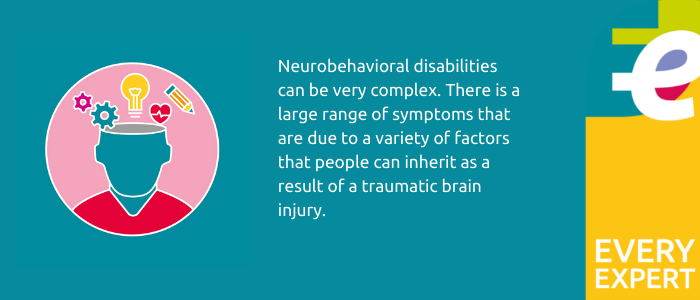
Nick: “Neurobehavioral disabilities can be very complex. There is a large range of symptoms that are due to a variety of factors that people can inherit as a result of a traumatic brain injury. For example, there’s the organic damage to the brain itself. When the damage is to the frontal part of the brain this can have a significant impact on a person’s life within the community, because this is the part of the brain that’s responsible for controlling behaviour and picking up feedback. A function of the frontal lobe is also to enable us to adapt our behaviour to new and novel situations.
“So, when people have frontal lobe damage as a result of a TBI, not only are they more likely to have challenging behaviour, they can often have real difficulties in coping with novel situations. This produces a sort of dilemma as in situations, like a formal conversation or structured exchange, where people are well rehearsed in the behaviour, because before injury the behaviour was just habitual, there are no obvious problems. The person can seem to be functioning ok. This is why individuals can perform well in formal assessments but outside of the assessment they actually struggle in many aspects of life.
“As soon as you put someone into a new or novel situation where they’ve got to think on their feet, you see problems with planning and organisation. This can easily result in frustration, and because they may also have difficulties inhibiting behaviour as another legacy of TBI, they may express this by shouting or being aggressive, which can be frightening and intimidating to other people.
“So that’s the organic damage, but of course there’s damage to function as well, particularly to cognitive function, memory, attention and planning skills.”
So neurobehavioural disabilities is about a lot more than just challenging behaviour or aggression?
Nick: “Yes, exactly. It’s about all different sorts of impact on people that have a very subtle, but in many cases, a very catastrophic effect on their day-to-day lives. One common example is that individuals can often have difficulties with the ability to attend to multiple events. For instance, let’s take myself as I’m speaking here now. I’m having to think about what I’m saying, what I’m about to say, I’m looking at you to see if you’re paying attention to gather some feedback. So I’m having to process lots of things at the same time and that has an impact on my behaviour.
“For individuals with brain injury, often their ability to monitor, in that sense, is much more restricted. So in social situations where an individual with TBI is engaging in conversation with another person, and somebody else joins that conversation, perhaps the conversation changes direction, the individual with TBI can struggle to respond appropriately.
“Somebody with these sorts of difficulties can’t pick up on the fact that the conversation has changed, because they’re so intent on monitoring their own output in terms of their verbal behaviour. As a consequence, their behaviour therefore becomes socially inappropriate because they’re not adjusting it to the new set of circumstances. It can often be labelled as rude or ignorant, when they’re not deliberately being so. The behaviour is a product of the cognitive problems they have.”
And these are considered quite basic social interactions – conversations, exchanges etc. So if an individual can’t manage this it can be quite limiting on what they’re able to do in everyday life.
Nick: “Absolutely, and this issue is often missed in formal assessments – because of the reasons explained earlier. People will think of things like aggression because that’s easy to conceptualise and much easier to measure. But when it comes to the social niceties it’s much more difficult to establish their impact.
“For clinicians working face to face with individuals with brain injuries, we have long been cognisant of these issues but there weren’t really any good instruments out there to measure neurobehavioural disability in the round. That’s why we developed the SASNOS and why it’s important from a rehabilitation point of view. We need global measures to give us this all round assessment, otherwise they’re biased. If clinicians are only measuring aggression, for example, they’re not measuring these other very subtle symptoms that are often the bigger problem.
“The other thing is, which led to the development of the SASNOS, was the fact that nearly all of the measures that were being used had been modified from psychiatry so they hadn’t been specifically developed for brain injury. There’s obviously an assumption on the part of people who think that the psychiatry of aggression is going to be the same as the psychiatry of brain injury, and they’re not. The drivers are completely different.”
So let’s talk about your recent paper, looking at the use of the SASNOS in the community. What was the reasoning behind the study?
Nick: “The main motivation was to try and illustrate the prevalence of neurobehavioural disability holistically, not just with aggression, but with the whole range of symptoms that individuals experience. The SASNOS has been used extensively in patient settings. We’ve successfully been able to compare the prevalence and severity of neurobehavioural disability for people in specialist neurobehavioral units such as the Avalon Centre.
“But, we know from the research, that most people who have these sorts of difficulties are out in the community and they don’t get access to the appropriate support. There are 1.3 million people, it is estimated, that are living in the community with the long-term effects of an acquired brain injury, including traumatic brain injury. The research shows that these difficulties are chronic, they don’t go away and they don’t tend to get better. They are more disabling in terms of community reintegration than physical disabilities. They are the reasons why marriages and families break up, why people have hit out at home and ended up in prison or on the streets, or in long term psychiatric care.
“So the motivation to look at the community group is very much from that point of view. In the paper we show that the difficulties weren’t as severe as you would find in patients who’d been admitted to specialist neurobehavioural programmes, because they’re a particular sample. But the difficulties were still quite severe, even for violence and aggression. Particularly with interpersonal relationship problems and problems with cognitive function.”

Was there anything particular about the community sample in your study?
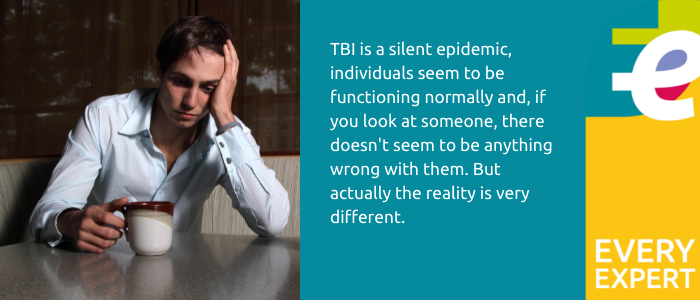
Nick: “Well the main point to stress here is that these individuals looked for all intents and purposes like they are fully recovered. However TBI is a silent epidemic, individuals seem to be functioning normally and, if you look at someone, there doesn’t seem to be anything wrong with them. But actually the reality is very different.
“It’s only when people are put in situations where their ability to direct frustration gets tested, or they are put into a very unique situation and they don’t have the capacity to cope. They’ve lost the ability to plan and change behaviours. If they’re in novel or new situations their difficulties really come to the fore.”
Could we talk a little more about contextualizing and self-awareness i.e. the individual has an awareness that they have this disability or that they’ve been impacted in this way. Does this self-awareness help them to manage behaviour and responses?
Nick: “You’d think it would, but it doesn’t always. Some people are very insightful about what has happened but this can lead to an increase in depression because they are very aware that their situation has changed. Others have less awareness and insight. For example, if you ask relatives or someone that knows the individual well, and talk to them about their difficulties, there’s often a disconnect. Relatives can describe numerous difficulties and then we talk to the person with TBI and they might say “I don’t have any problems and I don’t know why I’m here today”. It can be a barrier for rehab because if people don’t recognise that they are experiencing difficulties, they won’t necessarily want to seek out rehabilitation.
“An advantage of the SASNOS is that it has two versions. One version that people that know the person with TBI can complete, and another version that the person themselves can complete. So clinicians and researchers can look at that paradox.”

If the individual who has TBI doesn’t have that insight into their situation, they’re not going to come forward for help, so do you have to rely on the families to come forward?
Nick: “Yes often we do, the families are usually the torch bearers or flag bearers for trying to get their relatives into a rehabilitation programme. Or it’s because their behaviour is such that they’ve got into trouble with the law, and may need residential neurobehavioural support.
“An individual can suffer a TBI and make a good physical recovery whilst they are in hospital, because they’re in an environment that’s structured and supported. They get to know the environment and can make progress. However when they get discharged, often without a follow up, they’re just left to get on with it and that’s where the difficulties begin to show.
“That’s why it’s quite unusual for us to see patients within months of injury, it’s usually years before the full social impact of the injury is felt. So this is why the SASNOS is important, it makes these hidden disabilities, that have such a catastrophic impact on daily life, apparent and visible which gives them substance. And it can be done much more quickly, hopefully reducing the negative impact on the individual and their family.”
Thanks for your time today Nick, as we conclude our conversation is there anything else you’d like to add?
Nick: “Well I’d just like to reiterate the importance of continuing to try and educate people and raise awareness of the issues for individuals with TBI who are living within the community. I often refer to the startling statistic that there are 1.3 million people living with TBI in the UK, many of whom are living without adequate support. As a silent epidemic, they are hidden from sight, until their difficulties become so great they need help from residential services.
“The figure of 1.3 million people just refers to TBI but if you add to that the number of people with other forms of acquired brain injury, that’s a sizable portion of the population. And if this article can contribute to that growing movement of raising awareness and education, that would be a very positive contribution.”
Make An Enquiry
If you’d like to make a referral then please get in touch with us.
You can also visit each service’s profile page to find out more about what our EveryExpert approach to care looks like in practice:
Adderley Green, Staffordshire
Badby Park, Northamptonshire
Garden & Jacobs, Hertfordshire
St Neots, Cambridgeshire
Stanley House, Herefordshire
The Avalon Centre, Wiltshire
The Bridge, Middlesbrough, Wiltshire
The Dean, Gloucestershire
