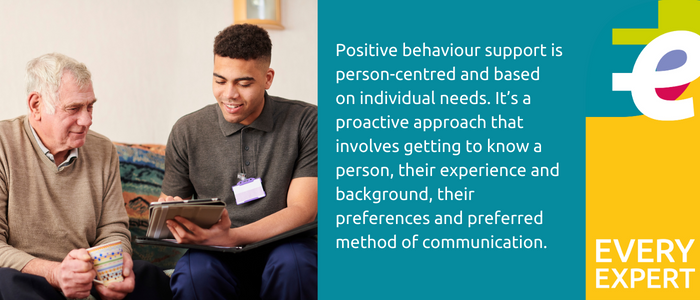
Positive behaviour support is person-centred and based on individual needs. It’s a proactive approach that involves getting to know a person, their experience and background, their preferences and preferred method of communication. At the centre of this approach is reducing the need for restrictive interventions when working with behaviour that challenges. Instead the causes and conditions for that behaviour are identified and through collaborative working by an multi-disciplinary team (MDT) less restrictive interventions are put in place.
In this article we talk with Niall Diggin, TMVA (Therapeutic Management of Violence or Aggression) Regional Lead across the Elysium Neurological division. Niall leads a team of 20 TMVA tutors who support around 500 individuals receiving specialised rehabilitation and long-term complex care with a broad range of neurological conditions, acquired brain injuries and spinal cord injuries.
Niall’s target is to reduce behaviour that challenges across all Elysium’s neurological services and improve rehab outcomes or quality of life for each individual. As Niall explains, achieving that goal requires a combination of team work, training and detailed documentation and analysis.
Hi Niall, thanks for talking for us today. So for the benefit of readers who may not be familiar with restrictive practice, could you explain what it is within the context of neurological care and rehabilitation?
Niall: “Of course. So first let’s consider the individuals that we support within neurological care and rehabilitation. Typically, they experience a change in their behaviour as a consequence of the injury to their brain or the organic process developing and changing the way their brain processes things. Often a typical response to any sort of challenge would be to physically intervene and stop someone from continuing with that behaviour behaviours.
“But we have a different approach to restrictive practice at Elysium, we aim to use the least restrictive interventions possible. Instead we try to find a different way to get that person to do something else. For example, if an individual is urinating on the floor, there is a possibility that at that moment they don’t know where the toilet is located. We have to educate that person with signs or verbal prompts, to show them where the toilet is, rather than physically stopping them. So we try to support the person to do something differently, rather than introduce restrictions.”
Can you tell us more about your role as TMVA Regional Lead across Elysium’s neuro services?
Niall: “I manage around 20 TMVA tutors, who in addition to their day-to-day roles in our services, train our team members in conflict resolution, breakaways and therapeutic management of violence and aggression. As part of this training we provide examples of restrictive practice and how it can be changed into a least restrictive practice, and at the centre of this methodology are Positive Behaviour Support (PBS) plans.
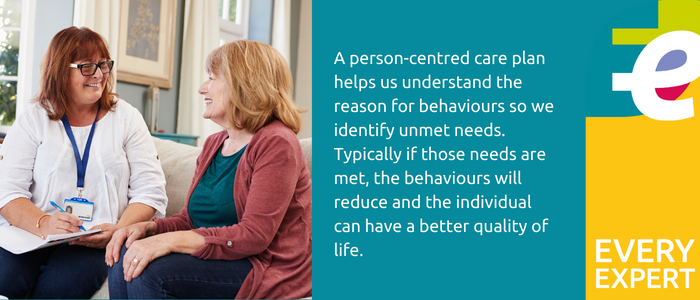
“Behaviours that challenge are usually the result of an unmet need and it’s our job to figure out what that is, and that’s where the PBS comes in. It’s a person-centred plan that helps us understand the reason for the behaviour and once we do that we can help meet those needs. Typically if those needs are met, the behaviours will reduce and the individual can have a better quality of life. If someone’s being aggressive, we try to understand why are they being aggressive, what is the trigger for that behaviour? So we start from there, work our way through and identify the positives to stop that person hitting the trigger.”
As with any behaviour, it doesn’t happen in isolation and there must be multiple reasons for it, so how do you figure out what is a trigger?
Niall: “Exactly, there will be a mixture of lots of different things, and we use ABC (antecedent behaviour consequences) recording sheets to figure that out. The antecedent is the events, action, or circumstances that occur before a behaviour. For example, an individual might grab someone or hit out at someone. When we work through the behaviour, the antecedent might identify that they were in a lounge area and it was noisy and they don’t like the noise. However, it is not always as straight forward as that because there might be another incident where it was really quiet when they showed aggression, so it really does require thorough and ongoing reviews which involve the whole MDT.”
Yes I imagine it must involve the whole team and a lot of reflection and analysis because it may be very difficult to figure out the cause in the moment.
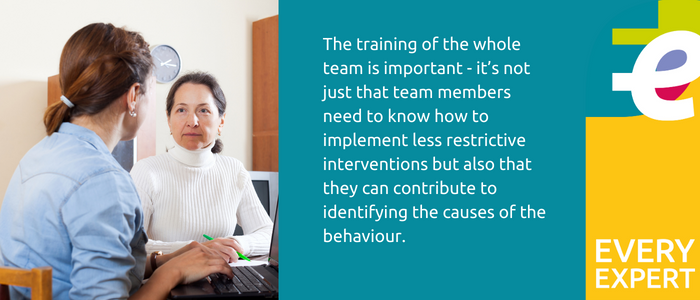
Niall: “Yes and that’s why we document everything so that we can learn as much as possible from the incident but also so that we can compare incidents to identify patterns. This is why the training of the whole team is important – it’s not just that team members need to know how to implement less restrictive interventions but also that they can contribute to identifying the causes of the behaviour. The team member present at the incident would record the ‘ifs, the whys and the whats’ – so what were they doing before, what was going on at the time, what did the person do and how did they respond. Then we’ll review the detail in our documentation and use that to fine-tune the PBS plan.”
The TMVA tutor has a really important role in ensuring the success of this approach, how are individuals chosen to become tutors?
Niall: “Well it first starts with recognising people who have a particular aptitude for this type of work, and we find the best way to identify those individuals is by getting other team members to nominate them. If you’re working alongside someone who is really good at communication, at de-escalation, and similar skills, plus they’re reliable as well, then you can give them a great recommendation. We want individuals who can put the theory into practice and if we can see that a team member does that on a day-to-day basis, and is recommended by other team members, then they’re going to be a strong candidate to become a tutor.
“We then run a three week course with those candidates to learn about interventions, and the full theory behind the practice. Candidates have to pass the course, it’s a pass or fail, so if the senior tutors feel they’re not ready then they won’t pass the course, so they have to work really, really hard. Nothing is guaranteed for them.”
How does limiting restrictive practice and using PBS benefit the individual?
Niall: Well in terms of individuals with acquired brain injuries who are going through rehabilitation, we’re enabling them to regain some valuable life skills. If an individual’s behaviour might cause them difficulty out in the community, we’re trying to enable those individuals operate successfully within society. We hope that PBS and non-restrictive practice improves rehab and makes the process much quicker so they can return home sooner. That’s what we’re trying to do, to extinguish these behaviours and get people to move on.”
And for individuals who might perhaps have Huntington’s disease, dementia or similar conditions and will not be living within the community again?
Niall: “So that’s about quality of life, we’re trying to enable them to maintain a quality of life, perhaps being able to eat a meal, or go out, and meet any needs that they might have.”
How do you think it impacts families?
Niall: “Families are very much part of the process and feed into the PBS. We have regular family meetings, and services have support groups for families. Our MDT is heavily involved in supporting families and the families come together as well, so they can share experiences.
“Family involvement is very important because we don’t necessarily know the individual and where they’ve been prior to our services. So when families come in and say “Oh he’s so much better, in the last place he would do x,y,z,” for example, you’re getting valuable feedback about how that person may have improved.”
It seems like you’ve made great progress in reducing restrictive practice across all of the neuro services at Elysium, but do you have any future targets or goals that you’d like to share?
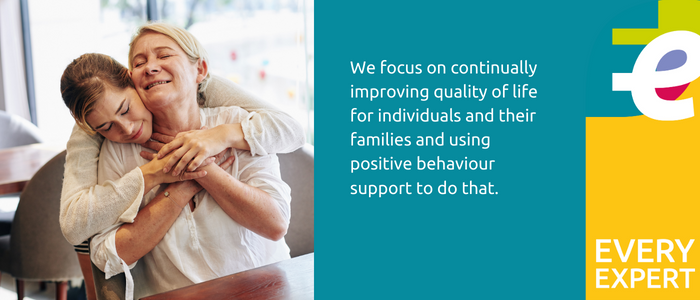
Niall: “Well the ultimate goal for all of our teams is to have no violence and aggression whatsoever. But we know that’s not going to happen, because of the conditions or injuries that the people we support are living with, however we focus on continually improving quality of life for individuals and their families and using positive behaviour support to do that.”
Then on a personal note, how does it make you feel when you see somebody who’s become able to manage their violence and aggression, and you know that less restrictive practice is a part of that progress.
Niall: “Well I think that’s the real strength of PBS and not using restrictive practice because I think you see those improvements in day-to-day activities. We’re always measuring progress so it feels great to see an individual make steady steps. But progress isn’t always linear, maybe an individual will go back a week and go forward a day, go back two months etc and then you finally reach a point where you’re like, ‘we’ve cracked it!’. It’s incredibly rewarding to see.”
Make An Enquiry
If you’d like to make a referral then please get in touch with us.
You can also visit each service’s profile page to find out more about what our EveryExpert approach to care looks like in practice:
Adderley Green, Staffordshire
Badby Park, Northamptonshire
Garden & Jacobs, Hertfordshire
St Neots, Cambridgeshire
Stanley House, Herefordshire
The Avalon Centre, Wiltshire
The Bridge, Middlesbrough, Wiltshire
The Dean, Gloucestershire
