Swallowing Awareness Day (16 March 2022) is an important opportunity to discuss the impact on daily life for people who live with eating, drinking and swallowing difficulties.
The initiative is part of NHS Nutrition and Hydration Week (14 – 20 March) and raises awareness about how Speech and Language Therapists (SLTs) support individuals who experience swallowing difficulties also known as dysphagia.
In this EveryExpert article we explore the work of SLTs and how their therapeutic approach supports the everyday tasks of eating, drinking and swallowing that most of us take for granted.
We demonstrate the impact of Mira Bou Akar, Lead SLT and the MDT at The Bridge, in Middlesbrough, through the story of resident RS, who experienced complications following bariatric surgery but has made significant progress during her first few months at The Bridge.
What is speech and language therapy?
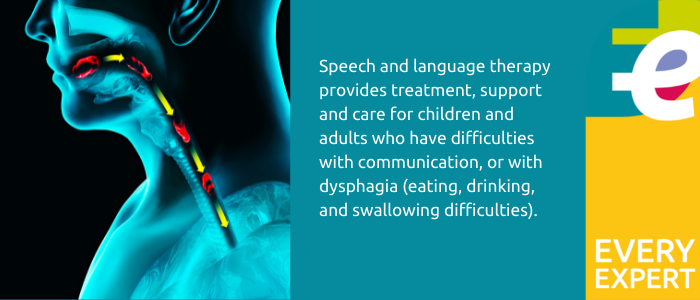
Speech and language therapy provides treatment, support and care for children and adults who have difficulties with communication, or with dysphagia (eating, drinking, and swallowing difficulties).
Dysphagia can vary in severity ranging from having issues swallowing certain foods or liquids, while others can’t swallow at all. Dysphagia can affect a person’s quality of life and can lead to other health complications, such as weight loss, repeated chest infections or aspiration pneumonia.
SLTs are allied health professionals and play an important role in assessments, care planning and therapeutic inventions. For example, if an individual is found to have communication problems then an SLT will work with them to implement communication aids to assist in either verbal or non-verbal communication.
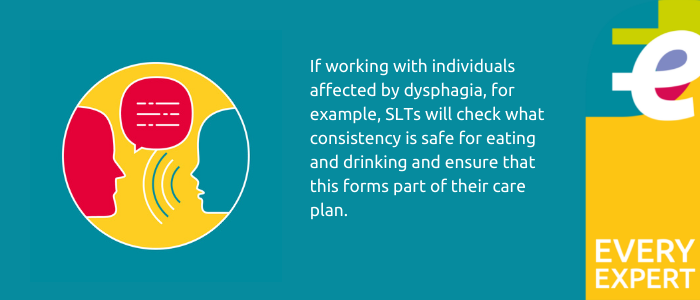
If working with individuals affected by dysphagia, for example, SLTs will check what consistency is safe for eating and drinking and ensure that this forms part of their care plan.
Resident RS’s story
RS was admitted to The Bridge in November 2021. She was treated for metabolic encephalopathy with motor sensory axonal on EMG testing. RS previously had a gastric bypass and had subsequently developed a kidney disorder. She also suffered from a fatty liver, gall-stones and an iron deficiency.
The Back Story
At the beginning of the year RS was admitted to hospital with fluid overload and suspected kidney problems so she was started on diuretic treatment. Unfortunately, she was readmitted with similar problems and on this occasion appeared to be confused on the ward with dizziness and collapsing episodes which happened throughout her inpatient stay. RS was treated for copper deficiency but experienced a sudden drop of consciousness requiring ITU intervention and invasive ventilation.
During her admission to ITU, RS’s ammonia levels were recorded as very high. The original cause was suspected as ‘protein losing enteropathy’ when albumin and other protein-rich materials leak into the intestine . It was felt this could be linked to previous bariatric surgery resulting in a post bariatric hyperammonaemia. RS was assessed as being malnourished with trace element deficiency. RS’s condition was discussed with specialist staff at the Salford Metabolic Centre.
RS was supported by multiple ventilators and acquired pneumonia during her inpatient stay making very slow progress with weaning from ventilation. During the weaning process it was difficult to wake RS but she was able to demonstrate motor activity which was encouraging. Brain imaging confirmed a metabolic encephalopathy. RS deteriorated and developed severe motor deficits which prompted further investigations under neurology. In August she went for Electromyography (EMG) testing. EMG tests measure muscle response or electrical activity in response to a nerve’s stimulation of the muscle. The tests showed severe motor sensory axonal neuropathy but the cause could not be established.
RS was admitted to The Bridge in November 2021 to continue the weaning programme and start her rehabilitation.
RS’s Abilities upon admission
- RS’s communication was via non-verbal means with head and eyes movements only. Previously RS had communicated with her tongue as well.
- A letter board required too much effort so the SLT developed personalised communication boards with pictures and words reflecting RS’s needs
- RS tried to speak but this resulted in non-intelligible word mouthing
- Reduced frequency of spontaneous saliva swallow.
- Swallow assessment with very minimal and restricted quantities (only a coated spoon)
Overview of assessments
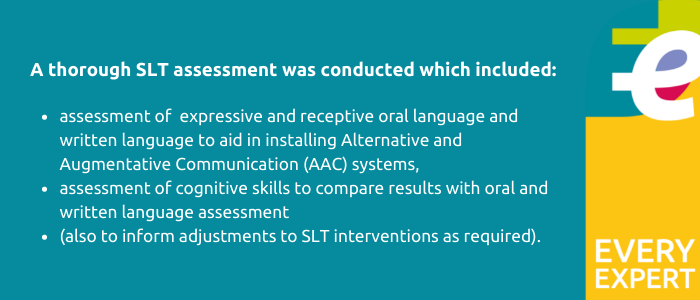
Upon admission a thorough SLT assessment was conducted by the team which included assessment of RS’s expressive and receptive oral language, written language to aid in installing Alternative and Augmentative Communication (AAC) systems, cognitive skills to compare results with oral and written language assessment and inform adjustments to SLT interventions as required.
The SLT team assessed and installed AAC and assessment of RS’s feeding and swallowing abilities.
Overview of therapy
Based on the results of the assessments the SLT team worked towards installing a consistent means of communication with head movements and various communication boards. They worked together with RS to complete questionnaires to assist in formulating AAC methods and tailoring it according to RS’s communication needs. The SLT also provided early swallow rehabilitation.
Family involvement was a priority from the outset. RS’s mum was involved with the multidisciplinary team meetings to help tailor the AAC specifically for RS and to provide family support, explanation of the SLT interventions, assessment results, and therapy plan.
MDT Approach
All the while the SLT team liaised with and coordinated the MDT team (physio, OT, dietician, nursing staff and HCAs) to achieve optimal results. All staff were involved in formulating RS’s AAC plan by checking RS’s daily needs and communication with staff members also taking into account feedback from RS’s partner and family.
Through multidisciplinary teamwork, the weaning program progressed with a change of tracheostomy tube from a cuffed to an uncuffed tube. The SLT also worked on the following areas:
- Improving verbal communication and attaining better vocal quality
- Improving breath support and control for better breathing/phonation coordination and to produce longer sentences
- Ongoing exercises to improve oromotor abilities
- Improving speech intelligibility and articulation accuracy
- Progressively reintroducing larger amounts of oral trials and conducting swallow re-assessments
Additional innovation in care
Mira Bou Akar, Lead SLT at The Bridge looked for cutting edge technology to support RS with her rehabilitation and to this end arranged for the involvement of national and international demonstrations and trials of AAC devices:
- Mira liaised with USA-Australia company for advanced AAC mean (NeuroNode Triology) that combined EMG, eyegaze, and touch switches. She arranged for demonstration, shipment, and trial of the device with residents at The Bridge (including RS). Several training and support meetings with the company were also arranged to assist in their device trial.
- Mira, along with the MDT team at The Bridge, liaised with the regional communication aids and environmental control services to formulate and install an appropriate AAC plan of communication.
- The team implemented a plan to support the improvement of RS’s oromotor abilities through oromotor therapy (exercises targeting muscle strength, range of movements, movement precision and accuracy and muscle coordination of the muscles involved in speech, eating and swallowing: lips, jaw, soft and hard palate, and larynx).
RS’s Abilities mid-way through her stay
- RS had better head control to use nurse call switch, sustaining visual tracking and visual fixation which helped her provide more accurate responses during speech and language assessments. This helped her benefit better from communication boards.
- With tracheostomy cuff deflation, RS was able to produce some more meaningful vocal sounds accompanying word mouthing.
- However, her speech was no intelligible due to:
- Poor breath support and control
- Poor phonation and breathing/ speech coordination
- Inaccurate articulation
- Verbal communication of needs was still challenging for RS at this point
Progress update at February 2022
- RS is now able to produce single to two words sentences with remarkably improved speech intelligibility
- She is able to communicate her basic needs verbally with less and less effort, improving her communication and interaction with staff members
- She has developed better breath support, control and coordination of breathing and speech
- Better articulation of sounds, improving overall speech intelligibility
- Re-assessment of swallowing was carried out with larger amounts of oral trials (these are to be continued and progressed)
- With improved verbal communication, more detailed assessments were possible, providing more accurate results
- RS feels very excited when she uses verbal communication and is given positive feedback so she can monitor her own progress
Feedback from the SLT
Mira Bou Akar, Lead SLT at The Bridge is full of praise for the progress RS has made and for her determination and engagement in the programme.
The support of family and friends is often crucial to the progress made by residents with communication, swallowing and other rehab needs. Mira also credits the MDT approach at The Bridge and the strong culture of team work for the success.
Mira continued:
“At The Bridge we hold regular MDT meetings which makes our work a lot easier and faster – the better coordinated the team, the more success we can have with residents”.
“Improving quality of life and outcomes for residents is all about teamwork. For example, with resident RS we have a weaning programme in place and we work together to ensure that has the best chance of success. The OT did an amazing job to seat her upright which was vital because otherwise we wouldn’t be able to achieve the position needed for RS to swallow safely”.
“The Nursing team also spent time observing and monitoring RS, ensuring she maintained appropriate oxygen levels etc. This has been a real team success and best of all seeing the recovery RS is making.”
Next steps for RS
RS will now receive ongoing speech and language therapy for:
- Improving her verbal communication to produce longer sentences
- Further swallow rehabilitation with oral intake review and re-assessment
- Supporting RS and her family with the next steps in her rehabilitation journey
Therapy Outcome Measures (TOMs) are used in the service so we can evidence the gains that a person is making as a result of our therapeutic programmes. These show continued levels of progress in dysphagia, dysarthria and voice.
Find more information about the services available at The Bridge Neurological Care Centre, or by contact the Partnership Development and Referrals Manager for the service, Misty Walters by e-mail at misty.walters@nhs.net.