

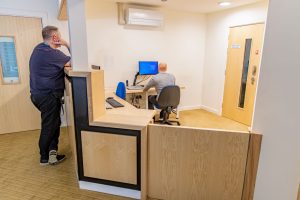
 The nursing station on newly-built Taliesin Ward at Aberbeeg Hospital is different from other nursing stations. Drawing on research (Southard et al., 2012) which evidences that open nursing stations break down barriers between staff and patients, the nursing station on Taliesin Ward has a low stable door, has no screens or windows and is open to the ward communal area.
Traditional desktop computers are replaced with laptops, which can be used at the station or taken into the clinical area to work collaboratively with patients. Displays of relevant sensitive information are placed elsewhere or online where possible. It is expected that the environment will appear less hostile to patients.
Background
There is a trend towards open nursing stations in the design of new wards, as well as evidence that they are preferred by patients, but little evidence exists on their use in forensic settings. The nursing station, traditionally a closed office, is a core element of ward design and is often at the centre of procedural security in secure mental health wards. As well as providing physical protection, it can also communicate to patients that they are dangerous, rather than people in need of healing.
A Study
A planned prospective study is being undertaken at Aberbeeg Hospital. Incident reports for the new ward over the first year of opening will be analysed for whether the open nursing station design was a factor in the incident, and if so, to what extent. Semi-structured patient interviews will be conducted with all consenting patients admitted to the ward who have experience of at least one other medium secure environment.
We are not aware of any other Medium Secure ward in the United Kingdom which has incorporated an open nursing station design. If the positive patient experience reported in studies of similar designs in general psychiatric settings can be reproduced, while demonstrating that it is not associated with undue risk, we hope the open nursing station could become a feature of secure units in years to come.
Feedback
Feedback for the open nursing station is positive, with both staff and patients feeling that the nurse/patient relationship is able to develop much more positively without screens and windows.
Ward manager: The patients seem more relaxed and at ease on the ward. I think the open plan design of the ward office improved communication between the nursing staff and the patients. It seems to have a positive impact on the nurse/patient relationship.
Patient: I like it because I don’t need to keep knocking on the office door. In the normal style of nurses’ office on other wards, it’s a constant thing of knocking on the door if you want something which is boring and sometimes frustrating. Here we can just talk to the nurses like normal.
Staff Nurse: It is a different way of working. I think there are different risk assessments of the environment that need to be done to make it work. We have had to change a few small design things since it opened, such as putting a Yale lock on the stable door so that it closes and locks automatically. I think the risk assessments required are worth it though, it seems to be a better way of working.
Patient: As soon as you come on the ward and see that office, you feel more relaxed because it doesn’t look hostile. It looks open and welcoming.
References:
Southard, K., Jarrell, A., Shattell, M., McCoy, T., Bartlett, R. and Judge, C., 2012. Enclosed Versus Open Nursing Stations in Adult Acute Care Psychiatric Settings: Does the Design Affect the Therapeutic Milieu?. Journal of Psychosocial Nursing and Mental Health Services, 50(5), pp.28-34.
Shattell, M., Bartlett, R., Beres, K., Southard, K., Bell, C., Judge, C. and Duke, P., 2015. How Patients and Nurses Experience an Open Versus an Enclosed Nursing Station on an Inpatient Psychiatric Unit. Journal of the American Psychiatric Nurses Association, 21(6), pp.398-405.